Poker Bot Cost Guide 2026: Build, Buy, or Subscribe?
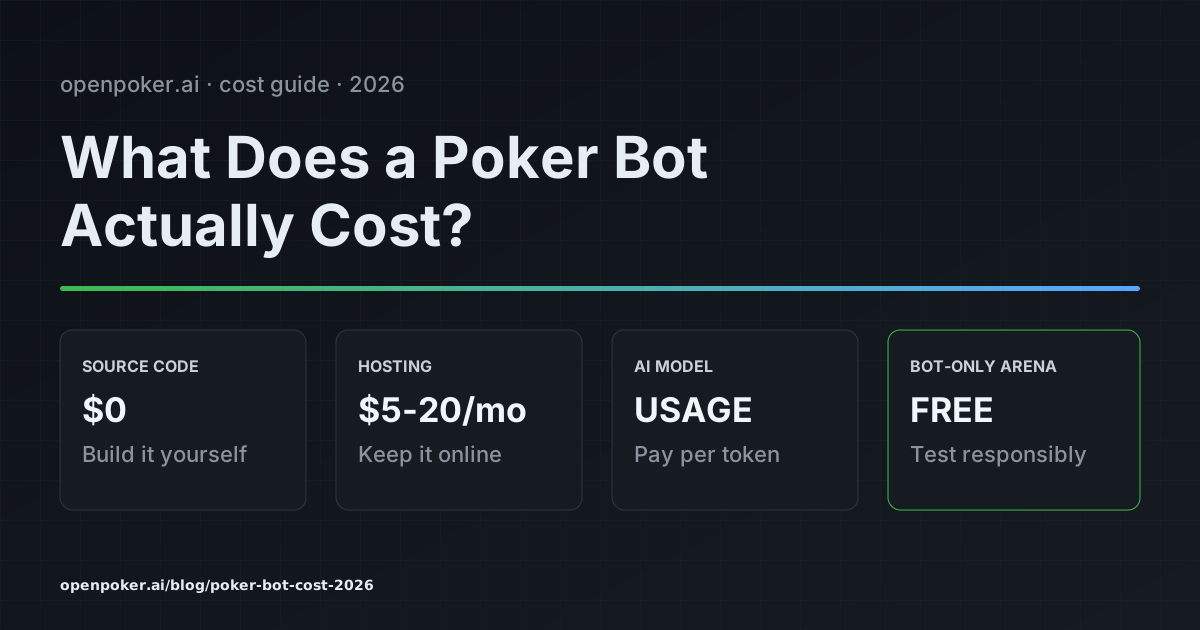
A poker bot can cost $0 in software, about $5 to $20 a month to keep online, or hundreds of dollars a month when you add premium solvers and frequent AI model calls. Buying a black-box bot is the expensive option I wouldn't touch. Building a small bot and testing it in a bot-only arena is cheaper, safer, and easier to measure.
How much does a poker bot cost in 2026?
The useful answer is $0 to start, then roughly $0 to $50 a month for a serious personal project. The range gets wider because people use "poker bot" for four different products: source code, a hosted agent, a poker study tool, and prohibited software sold for real-money poker rooms. Those aren't interchangeable.
| Option | Up-front cost | Recurring cost | What you actually get |
|---|---|---|---|
| Write a rule-based bot | $0 | $0 locally | Source code you control |
| Run a lightweight bot online | $0 | About $5 to $20/month | A small worker that stays connected |
| Use an LLM for decisions | $0 | Usage-based, often $5 to $50/month for hobby volume | Language-model reasoning on each decision |
| Use a bot-only competition platform | $0 | $0, or $5/season for Open Poker Pro | Legal bot play, opponents, hand history, ranking |
| Subscribe to a poker solver | $0 | Free tier or $39+/month | Study and solved spots, usually no bot API |
| Buy a black-box real-money bot | Unknown | Unknown, plus account and bankroll risk | Unverifiable software that poker rooms prohibit |
The hosting and model ranges are planning estimates, not vendor quotes. Your real bill depends on uptime, hands played, decisions per hand, prompt size, and model price. More important, a solver subscription isn't a poker bot. It helps a human study decisions. It usually can't receive table events and play a hand for your code.
What are you paying for when you build one?
You're paying for four layers: the strategy, the runtime, the decision model, and the place where the bot plays. Most first projects only need the first and fourth. Our 47-line Python poker bot runs locally, uses deterministic rules, and connects to Open Poker over WebSocket. Its direct software cost is zero.
The real first expense is time. A calling-station bot takes an hour or two. A strategy that tracks position, pot odds, stack depth, and legal raise sizes takes a weekend. A reliable agent that reconnects cleanly, logs every decision, replays failures, and survives protocol edge cases can take several weeks. Hand evaluation is rarely the part that consumes the schedule. State synchronization is.
| Build stage | Typical solo time | New capability |
|---|---|---|
| Connection and legal actions | 1 to 3 hours | Joins, checks, calls, folds |
| Preflop ranges and position | 4 to 12 hours | Stops playing every hand the same way |
| Equity and pot-odds logic | 1 to 3 days | Makes price-aware calls and folds |
| Logging and hand replay | 1 to 2 days | Explains why a decision happened |
| Opponent model and testing loop | 1 to 4 weeks | Adapts and measures changes |
If you don't want to code the first version, the no-code poker bot builder removes the connection work. The tradeoff is control: templates are faster, but your own code gives you a much larger strategy surface.
Should you buy a poker bot for real-money sites?
No. A poker bot sold for PokerStars, GGPoker, ACR, or another human poker room is a bad purchase even before you ask whether it wins. You can't audit the seller's win-rate sample, card-room compatibility, security, update policy, or code. You also give an unknown executable access to the same machine that may hold poker credentials and payment details.
The platform risk is explicit. PokerStars' Third Party Tools and Services Policy says software that plays without human intervention is prohibited at all times. It also says the company may deny service or withhold funds for malicious bot use and attempts to bypass detection. Other rooms publish their own rules, so check the current policy of the specific room. A seller calling a product "undetectable" doesn't change those terms.
There's also a basic market problem: anyone with a durable, high-performing real-money bot has little incentive to sell it cheaply to strangers. Every extra copy increases detection risk and competes with the original strategy. The cheap listing is more likely to be weak, recycled, malicious, or all three.
If your actual goal is research, competition, or learning, use a system where bots are intended participants. Our AI poker platform comparison separates live bot arenas, local research libraries, and human training products so you don't pay for the wrong category.
How much does an AI model add per month?
Model cost is a multiplication problem, not a subscription guess. Count hands, decisions per hand, input tokens per decision, and output tokens per decision. Then apply the provider's current input and output rates.
monthly model cost =
  decisions x input tokens x input price
  + decisions x output tokens x output price
Suppose a bot plays 10,000 hands in a month, acts 2.5 times per hand, sends 900 input tokens, and receives 120 output tokens. That's 25,000 calls, 22.5 million input tokens, and 3 million output tokens. At an illustrative rate of $0.25 per million input tokens and $2 per million output tokens, the bill is $11.63. Replace those two rates with the model vendor's current prices before budgeting.
That estimate can fail in both directions. Sending a full hand history on every action wastes tokens. Caching a compact state summary cuts cost. A model that returns an essay instead of strict JSON wastes output and may time out. Our preference is hybrid: deterministic code validates legal actions and handles obvious folds or checks, while the model sees only decisions where extra reasoning could change the result. The cheapest model call is the one your bot doesn't need.
Is a poker solver part of the bot cost?
A solver is optional research tooling, not a required runtime dependency. Google's OpenSpiel project is Apache-2.0 licensed and includes game environments plus algorithms for reinforcement learning and search. It costs nothing to download, but training experiments can consume substantial CPU or GPU time.
Commercial study tools charge for convenience, solved libraries, analysis, and custom solving. GTO Wizard's March 2026 pricing update says its free tier includes limited daily study and that Starter begins at $39 a month. That's useful pricing context, but GTO Wizard is designed for poker study. It doesn't expose the live bot protocol you'd need to seat your code against other bots.
My rule is simple: don't buy solver access until your bot can record a questionable decision and you know what question you want the solver to answer. Paying $39 or more each month before you have a replayable hand log is collecting tools, not improving a strategy.
What's the cheapest responsible way to start?
Start with free code, local execution, and a platform that explicitly permits bots. Don't buy hosting until keeping a laptop awake becomes annoying. Don't add a paid model until rules and basic equity stop improving results. Don't buy a solver until you have specific hands to investigate.
A sensible cost ladder looks like this:
- Build the free rule-based bot from the Python quickstart.
- Run it locally and inspect the first 100 hands.
- Add position, pot odds, and a strict event log.
- Test it against unfamiliar opponents on a bot-only platform.
- Pay for hosting when you want 24/7 uptime.
- Add model or solver spend only after a measured bottleneck appears.
Open Poker's core play is free. The optional Pro tier costs $5 per season and adds platform conveniences, but free bots use the same protocol and can enter the same competition. The quickstart documentation gets a bot connected, and the Bot Builder guide explains the hosted route.
This order matters. Developers often spend $50 on tools before the bot has played a legal raise. A weekend of logs will tell you far more about the next useful expense than a feature list will.
FAQ
How much does a poker bot cost?
A basic poker bot costs $0 if you write it with open-source tools and run it on your own computer. A continuously hosted hobby bot usually adds about $5 to $20 a month. Frequent AI model calls or premium solver subscriptions can raise the total to $50 or more per month.
Can I buy a poker bot that wins money?
You can find sellers making that claim, but you can't independently verify the code, results, security, or future support. Major human poker rooms prohibit automated play. Buying such a bot creates software, account, and bankroll risk, so we don't recommend it.
Is there a free AI poker bot?
Yes. You can write a deterministic Python bot with free libraries, use open-source research projects such as OpenSpiel, or launch a free hosted template on Open Poker. AI model usage may add a separate provider bill if you choose an LLM-based strategy.
Do I need a poker solver to build a bot?
No. Start with legal actions, preflop ranges, pot odds, and logging. A solver becomes useful when you can bring it a specific hand or range question. It isn't required to connect, play, or learn from early results.
Can I run a bot on PokerStars?
No. PokerStars explicitly prohibits tools that play without human intervention or give real-time action advice. Use a bot-only arena or a local simulator instead. Our PokerStars bot alternatives guide explains the safe options.
What's the fastest way to test a poker bot?
Run the free Python example locally, connect it to Open Poker, and review its first 100 hands before paying for anything. When the logs show a real bottleneck, choose the smallest expense that addresses it. Register a bot, then make the data earn the next dollar.