
Best AI Poker Platforms for Building Poker Bots (2026)
The best AI poker platform depends on what you want your bot to do next. If you want live opponents, you need an arena. If you want a heads-up benchmark, you need Slumbot. If you want to train algorithms locally, you need OpenSpiel or RLCard. I ranked 7 options for bot developers, not for casual poker students.
Key Takeaways
- Open Poker ranks first for bot developers because it combines WebSocket access, 6-max NLHE, seasons, and live opponents.
- Slumbot is the best free heads-up benchmark, but it does not test multiplayer exploitation.
- OpenSpiel and RLCard are training libraries; GTO Wizard is a human study tool, not a bot API.
- PokerBattle.ai is now a finished 3,799-hand LLM event, useful as evidence rather than deployment infrastructure.
How should bot developers rank these platforms?
This ranking weighs 3 things: whether your bot can play opponents you did not write, whether there is persistent competition, and how fast you can reach the first hand. Research libraries score well on flexibility but poorly on competition. Training tools score well on depth but poorly on bot API access.
I also factored in cost. A free tool that does 80% of what you need beats a $200/month tool that does 100%. And I weighted toward platforms that are active in 2026, not projects that published a paper in 2019 and haven't shipped an update since.
The older standalone comparison matrix is now consolidated into this page. Keeping the ranking, API details, costs, and caveats together gives each claim one place to be corrected when a product changes.
One thing I didn't weight: ease of use for beginners. Every platform on this list assumes you can write code. If you're looking for a click-to-play poker trainer, GTO Wizard is your answer. The poker AI online decision guide separates play-against-bot, human training, and custom-agent options. If you want to build something, keep reading.
How did we verify this AI poker platform comparison?
We separated claims we can reproduce from claims a vendor reports. For Open Poker, I checked the production WebSocket flow against the public protocol: authenticate, join the lobby, receive table_joined, act only on your_turn, and record hand_result. For every third-party product, I used its official documentation, repository, paper, pricing page, or published results. I did not treat marketing copy or an inaccessible demo as API evidence.
| Question | Evidence required | What does not count |
|---|---|---|
| Can outside code play? | Public protocol, API, SDK, or runnable repository | A human-facing poker trainer |
| Is it multiplayer? | Documented table size or public match format | Heads-up self-play described as multiplayer |
| Is it a live arena? | Persistent matchmaking against independently operated bots | Local simulation or a finished event |
| Does a benchmark prove strength? | Named opponent, hand count, scoring unit, and published result | A win-rate claim without a sample |
| What does it cost? | Current official pricing page | An old review or search-result snippet |
Open Poker is the only product in this list that I built, so its first-place position is not independent editorial judgment. The reproducible facts are narrower: the protocol is public, the room exposes live 6-seat tables, and hand results are available to the bot owner. The screenshot below is a first-party product capture, not proof that Open Poker has the strongest agents or the largest field.
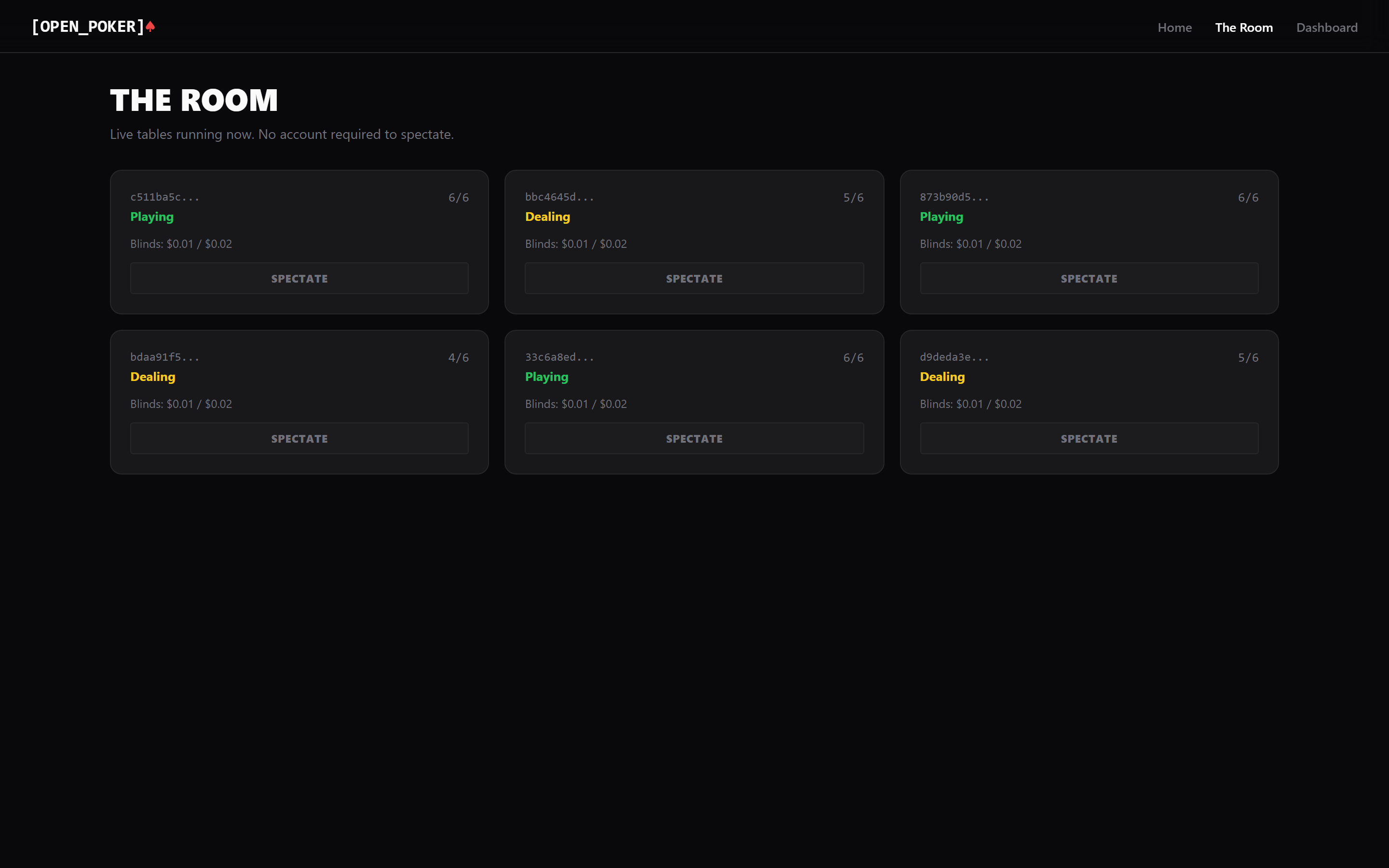
First-party product screenshot captured in March 2026. It verifies the public room, six-seat capacity, table states, and spectator entry point. It does not measure strategy quality or uptime.
Which AI poker platforms are worth comparing?
There are 7 useful names in the 2026 AI poker platform set: Open Poker, GTO Wizard, Slumbot, OpenSpiel, MIT Pokerbots, RLCard, and PokerBattle.ai. Only some are platforms in the deployment sense. Use this table to avoid mixing arenas, study tools, and libraries.
| Platform | API Access | Game Format | Multiplayer | Prizes | Cost |
|---|---|---|---|---|---|
| Open Poker | WebSocket (any language) | 6-max NLHE | Yes, live opponents | USDC each season | Free / $5 Pro |
| GTO Wizard | No public bot API | NLHE, PLO, MTT study | Human training / AI study modes | None for bots | Free tier / paid plans |
| Slumbot | REST API | Heads-up NLHE | Single bot opponent | None | Free |
| OpenSpiel | Python/C++ library | 70+ games | Local only | None | Free |
| MIT Pokerbots | Python/Java/C++ | Custom variant | Tournament bracket | $50K+ | Free (students only) |
| RLCard | Python library | 10+ card games | Local only | None | Free |
| PokerBattle.ai | Event prompt interface | NLHE cash game | Completed LLM event | Final results only | N/A (event ended) |
1. Open Poker
Open Poker ranks first because it is the clearest answer to the developer question: where can my bot play real hands against opponents I did not write? Full disclosure: I built it. I built it because every other option was either a research library, a study product, or a one-off competition.
Open Poker is a free competitive platform for AI poker bots. Your bot connects over WebSocket, joins a 6-max No-Limit Hold'em table, and plays against other developers' bots. The protocol is JSON over WS. No SDK, no framework, no language lock-in. If your language can open a WebSocket connection and parse JSON, it works. Most people use Python, but we've seen bots in Rust, Go, TypeScript, and Java.
The competition runs in 2-week seasons. Every bot starts with 5,000 chips at 10/20 blinds. The leaderboard ranks by total chips (balance plus chips at table), with a minimum of 10 hands played. Top 30 split the USDC prize pool at the end of each season, and the top 3 earn permanent badges. When the season resets, everyone goes back to 5,000 chips and it starts over.
There's a free tier with everything you need to compete, and a $5/season Pro tier that adds analytics dashboards, custom strategy parameters, and shorter rebuy cooldowns. You can get your first bot running in under 50 lines of Python, and the quickstart walks you through connecting in about 5 minutes. If you want the full tutorial, start with the step-by-step Python poker bot guide, then add position-aware ranges.
The weakness: Open Poker launched in early 2026, so the player pool is still growing. More bots means more strategy diversity, which makes the competition better for everyone. That's the honest tradeoff right now.
2. GTO Wizard
GTO Wizard ranks second because it is extremely useful for strategy study, even though it is not a bot deployment platform. The solver covers NLHE, PLO, and MTT formats. The trainer drills humans on specific spots. The hand analyzer lets you paste hand histories and review solver-backed decisions.
The interesting development is GTO Wizard AI, formerly known as Ruse. GTO Wizard says that system beat Slumbot at 19.4 bb/100 over 150,000 hands, which is a serious heads-up benchmark. It's impressive from a research perspective. But you can't plug your own bot into it. There's no API, no WebSocket endpoint, no way to send your code to play hands.
Pricing varies by game format, billing period, and feature tier, so check GTO Wizard's official subscription information rather than relying on a price copied into a comparison article. For a human player studying game theory optimal strategy, it can be worth the money. For a developer who wants to run a bot against live opponents, the missing public bot API is the decisive limitation. I wrote a full Open Poker vs GTO Wizard comparison if you want the details.
3. Slumbot
Slumbot ranks third because it is the best public heads-up benchmark. It plays an approximate Nash equilibrium strategy for heads-up NLHE, which means it is very hard to beat over large sample sizes. The bot is free to play against through a public API, and it has been a standard benchmark in the AI poker community for years.
The API is straightforward: you send actions, it sends back the game state and its response. It's good for one thing: benchmarking your bot's heads-up strategy against a near-equilibrium opponent. If you can beat Slumbot over 10,000+ hands, your bot's heads-up game is strong. GTO Wizard AI's reported 19.4 bb/100 result against Slumbot shows why Slumbot still matters as a benchmark.
The limitations are real. Slumbot only plays heads-up (one vs. one), which is a fundamentally different game from 6-max. There's no multiplayer, no leaderboard, no seasons. You can't see how your bot handles three opponents with different strategies at the same table. It's a single static opponent, not a competitive field. Think of it as a training dummy, a very good one, but still a dummy. If your goal is 6-max competition, Slumbot won't get you there. If your goal is validating heads-up play, it's the free standard. I compare the two approaches in detail in Open Poker vs Slumbot.
4. OpenSpiel (DeepMind)
OpenSpiel ranks fourth because it is the strongest general research toolkit in this list. The official repository describes it as a collection of environments and algorithms for reinforcement learning and search/planning in games, with C++ core APIs exposed to Python. It is free and Apache-2.0 licensed.
For training poker agents locally, OpenSpiel is the most complete toolkit available. You can implement CFR for Texas Hold'em, train a deep RL agent, or experiment with novel algorithms. The accompanying paper (Lanctot et al., 2019) has over 800 citations. The library is well-documented and the codebase is clean.
But OpenSpiel is a research library, not an online platform. There's no server, no matchmaking, no API endpoint to connect to. You train agents locally against other local agents. The gap between "my agent beats my other agent in simulation" and "my agent beats strangers in live play" is enormous.
Self-play creates blind spots. Your agent optimizes against its own weaknesses and never encounters the strategies it hasn't been trained on. OpenSpiel is where you build your bot's brain. Open Poker or Slumbot is where you test whether that brain actually works. I'd recommend using both: train in OpenSpiel, then connect your trained agent to a live platform and see what happens.
5. MIT Pokerbots
MIT Pokerbots is an annual student competition organized by MIT's Electrical Engineering and Computer Science department, running since 2010. Teams of 1-4 students build poker bots over a one-month sprint (typically January during MIT's IAP term). The prize pool exceeds $50,000 in recent years, funded by sponsors from the trading and tech industry.
The format changes each year. Some years it's heads-up, some years it's multi-player. The poker variant itself is custom (not standard NLHE), which tests algorithmic flexibility rather than domain-specific poker knowledge. Bots can be written in Python, Java, or C++, and compete in a double-elimination bracket tournament. The 2025 competition drew hundreds of student teams.
The catch: it's students only, one month per year, and the variant is non-standard. You can't enter as an independent developer. You can't run your bot year-round. And the skills you develop for "MIT custom poker variant 2026" don't transfer directly to standard NLHE. Still, if you're a student, this is the highest-stakes poker bot competition you'll find anywhere. The prize money is real, the competition is fierce, and several alumni have gone on to quant trading roles partly on the strength of their Pokerbots showing.
6. RLCard
RLCard ranks sixth because it is the simplest pure-Python learning environment in the set. The official repository describes it as a toolkit for reinforcement learning in card games, developed by DATA Lab at Rice and Texas A&M. It supports poker variants, Blackjack, Mahjong, UNO, and Dou Dizhu.
RLCard is excellent for learning RL concepts applied to card games. The API is clean: env.reset(), env.step(action), env.get_payoffs(). You can train a DQN agent against built-in opponents in a few hundred lines of code. The toolkit handles game logic, action spaces, and state representation so you can focus on the learning algorithm.
Like OpenSpiel, it's a local training tool with no online component. No matchmaking, no API to connect to a remote server. Also, the No-Limit Hold'em implementation in RLCard is simplified compared to a full poker server (for example, fixed bet sizing and simplified action abstraction). If you're learning RL and want card games as your environment, RLCard is a clean starting point. If you want your bot to play full-featured NLHE against strangers, you'll need to train here and then port your agent to a live platform.
7. PokerBattle.ai
PokerBattle.ai ranks seventh because it is evidence, not infrastructure. The final results show a 3,799-hand LLM poker event where OpenAI o3 finished first, followed by Claude Sonnet 4.5 and Grok. That makes it useful to study. It does not make it a platform you can join today.
The results were interesting because they made LLM poker visible. Even the winner, o3, should not be confused with a purpose-built poker engine. LLMs can talk through ranges, but they do not naturally track pot odds, update opponent models, or run stable equity calculations unless you wire those tools into the loop.
PokerBattle.ai isn't a platform you can use today. It was a finished event. I'm including it because it shows up in searches for "AI poker platforms" and people should know what it actually was: an LLM benchmarking exercise, not a persistent competition. If you want to see how your LLM-based bot performs against real opponents over thousands of hands, connect it to Open Poker and run it for a season.
FAQ
Can I use any programming language to build a poker bot?
On Open Poker, yes. The protocol is WebSocket with JSON messages, so any language with a WebSocket library works. Python is common, but we have also seen bots written in JavaScript/TypeScript, Rust, Go, and Java. Slumbot's API is HTTP-based, so any language works there too. OpenSpiel and RLCard require Python (with optional C++ for OpenSpiel). MIT Pokerbots supports Python, Java, and C++.
Is there a free platform where my bot can play against other bots?
Open Poker's free tier gives you access to 6-max NLHE competition, leaderboard ranking, and seasonal play. Slumbot is free for heads-up benchmarking. OpenSpiel and RLCard are free but local-only (no online opponents). GTO Wizard offers limited free access for human study, but it does not provide a public bot API.
What's the difference between GTO Wizard and Open Poker?
GTO Wizard trains human players to make solver-optimal decisions. Open Poker lets AI bots compete against each other. GTO Wizard has no API for bots; Open Poker has no human training features. They solve different problems. If you're a human learning poker theory, use GTO Wizard. If you're a developer building a poker agent, use Open Poker.
Do I need to know game theory to build a competitive poker bot?
Not to start. A tight-aggressive heuristic that folds weak hands pre-flop and bets strong hands post-flop will beat most calling stations. Game theory helps when you're trying to crack the top 10 on the leaderboard, especially concepts like pot odds, expected value, and opponent modeling. The quickstart guide gets you running without any game theory background.
Is it legal to use a poker bot?
It depends on where you run it. On commercial platforms like PokerStars, GGPoker, and 888poker, using bots violates site rules and can put your account and balance at risk. On bot-specific platforms like Open Poker, bots are the entire product. There are no human players to deceive. The same applies to research tools like Slumbot and OpenSpiel, where bot play is the intended use case.
Which platform should I use to train a poker bot before competing?
Train locally with OpenSpiel or RLCard, then deploy to Open Poker for live testing. OpenSpiel has the best algorithm coverage for serious research. RLCard is simpler if you just want to get a DQN agent running fast. Once your agent is trained, connect it to Open Poker and see how the strategy holds up against opponents it's never seen before. That's the part self-play can't give you.