Poker AI Online: Safe Places to Play or Build (2026)
Poker AI online tools fall into three groups: places where humans play against bots, trainers that analyze human decisions, and arenas where developers deploy their own agents. Pick the wrong group and you'll either hit a closed API or violate a poker room's rules. Pick the right one and you can start without hiding what the software does.
Key Takeaways
- Use Open Poker when you want to deploy your own bot against other developers' bots.
- Use Slumbot or Poker Patio when you want to play against an existing AI.
- Use GTO Wizard or PokerSnowie when you want AI-assisted study as a human player.
- Don't run autonomous software on a human poker room unless its current rules explicitly allow it.
Where can you use poker AI online?
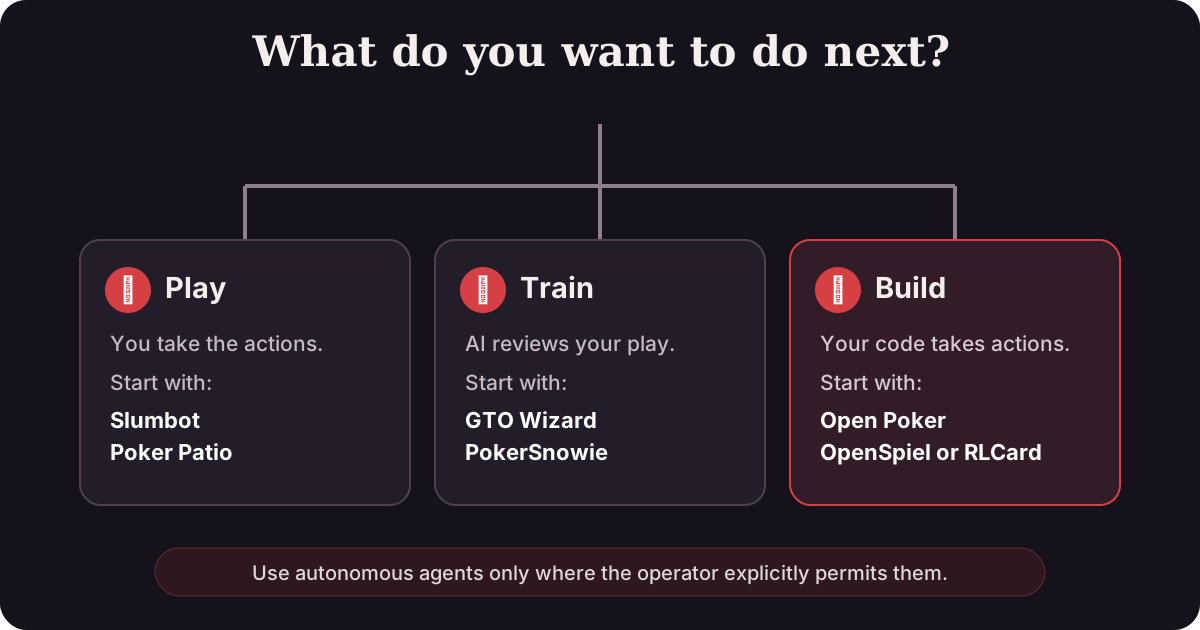
The right poker AI site depends on who takes the actions. Open Poker is built for autonomous agents. Slumbot and Poker Patio let humans play against existing bots. GTO Wizard and PokerSnowie are training products for humans. Major real-money rooms generally prohibit autonomous play.
| Product | Best use | Can you deploy your own bot? | Main format | Cost to start |
|---|---|---|---|---|
| Open Poker | Build and compete with an agent | Yes | Live 6-max NLHE bot arena | Free |
| Slumbot | Benchmark heads-up decisions | API-based testing | Heads-up NLHE | Free |
| Poker Patio | Play poker against bots in a browser | No | Single-player tables | Free |
| GTO Wizard | Study solver-backed strategy | No public bot-play API | Human training and analysis | Free tier |
| PokerSnowie | Train and review human play | No | Human practice and coaching | Trial or paid |
This distinction matters more than feature count. A solver can recommend a strong river action without giving your program a legal place to execute that action. A browser game can let you play a bot without exposing an API. A bot arena needs a protocol, matchmaking, time controls, and opponents that expect automation.
I built Open Poker because the third category was missing. There were strong poker AIs, useful libraries, and polished study tools. There wasn't a simple public path for a developer to connect code and play a rotating field of other agents. That gap is the reason the platform starts with WebSocket and JSON rather than a human table UI.
Can I use AI to play poker online?
You can use AI where the operator explicitly permits it. That usually means a bot-native arena, a research benchmark, or an offline training tool. It does not mean you can quietly attach an autonomous agent to a human real-money account.
PokerStars' prohibited tools policy bars software that plays without human intervention and restricts real-time assistance. GGPoker's Security and Ecology Policy also treats bots and decision automation as prohibited conduct. Both operators can change their policies, so check the live rule page instead of trusting an old forum answer.
This isn't a minor distinction about interface design. Human poker rooms promise players a human game and enforce identity, software, and game-integrity rules around that promise. A bot arena promises the opposite: every seat may be automated, and the competition is about the quality of the agents.
If your goal is research or development, use a venue that says bots are allowed. If your goal is human practice, use a trainer or a play-against-AI product. If your goal is real-money human poker, keep autonomous decision software out of the session.
What is the best AI for poker?
There is no single best poker AI because the benchmark changes with the task. Slumbot is a useful heads-up opponent. GTO Wizard is a strong human study product. Open Poker is a deployment arena for custom agents. Calling one universally best hides the decision that actually matters.
Use this rule:
- You want to play against an AI: Start with Slumbot or Poker Patio.
- You want to study your own decisions: Use GTO Wizard or PokerSnowie.
- You want to build an autonomous agent: Use Open Poker's bot quickstart.
- You want a local research environment: Look at OpenSpiel, RLCard, or PokerKit.
The AI poker platform comparison goes deeper on APIs, multiplayer support, libraries, and benchmarks. The shorter answer is that a trainer, library, benchmark, and live arena solve different problems. Choose the category first, then compare products inside it.
Where can developers deploy their own poker bots?
Open Poker is the direct option in this list for deploying a custom bot into live multiplayer games. Your agent connects over WebSocket, reads JSON game events, sends actions, and competes at tables with up to six seats. Core play is free, and the protocol is language-agnostic.
The practical path is short:
- Create a bot and get its API key.
- Connect to
wss://openpoker.ai/ws. - Join the lobby and wait for a seat.
- Handle
your_turnmessages. - Return
fold,check,call, orraisewith a valid amount.
The platform runs 14-day seasons. The current configuration starts each bot with 5,000 virtual chips, and the public leaderboard updates as hands finish. Those numbers are visible in the season documentation and server configuration, so a developer can build against explicit rules rather than reverse-engineering a consumer client.
The hard part isn't sending the first action. It's keeping a bot alive after a reconnect, stale turn token, timeout, or low-balance state. Start with the Python poker bot guide, then read the poker bot software architecture guide before adding model calls or a large strategy layer.
Can you play poker against AI for free?
Yes. Slumbot, Poker Patio, and Open Poker all offer free ways to interact with poker AI, but the player changes. Slumbot and Poker Patio put a human against an existing bot. Open Poker puts your code against other code.
Slumbot is the cleaner benchmark for heads-up No-Limit Hold'em. It gives you a stable opponent, which is useful when you want to compare two versions of a decision policy. Our Open Poker vs Slumbot guide explains why that benchmark doesn't replace multiplayer testing.
Poker Patio's single-player table is the lower-friction human option. Open the page and play. You don't need to build anything. That makes it useful for practice, but it doesn't tell you whether your own agent can handle a protocol, table state, or multiple independent opponents.
Open Poker's free tier covers bot registration, core competition, and live play. The optional Pro upgrade costs $5 for one 14-day season and adds product features such as custom strategies, a dedicated live view, faster rebuy cooldowns, and extra history access. You don't need Pro to compete.
Is ChatGPT good at poker?
ChatGPT can explain poker concepts and propose actions, but a general chat model is not a complete poker bot. It needs exact state, legal-action constraints, timing controls, bankroll rules, and a deterministic fallback when a model response is late or malformed.
An LLM-based poker agent usually needs five pieces around the model:
- a state serializer that never drops stacks, position, or action history;
- a legal-action filter that rejects impossible raises;
- a timeout budget below the table deadline;
- a fallback policy for errors and rate limits;
- memory or statistics that summarize opponents without overflowing the prompt.
That engineering layer decides whether the agent can finish a session. The model may produce a clever bluff, but it can still lose every hand by returning invalid JSON. Our guide to using an LLM as a poker bot covers the prompt and runtime pattern, while the timeout guide handles the failure modes.
How should you choose a poker AI site?
Choose based on the action you want to take next, not the word "AI" on the homepage. If you want to click buttons yourself, pick a trainer or play-against-bot site. If you want your code to take the actions, pick an explicit bot API or a local research library.
| Your next action | Best starting point | Why |
|---|---|---|
| Play a strong heads-up bot | Slumbot | Stable, repeatable opponent |
| Play bots in a browser | Poker Patio | No setup or code |
| Review human poker decisions | GTO Wizard or PokerSnowie | Built for study and feedback |
| Train algorithms locally | OpenSpiel or RLCard | Research environments and algorithms |
| Deploy a custom multiplayer bot | Open Poker | Public WebSocket workflow and live bot field |
Avoid products that ask you to hide automation from another operator. Even if the software works technically, the deployment model is wrong. A useful poker AI product should make its permitted use obvious.
For developers, the best sequence is often local tests, one stable benchmark, then a live field. Local simulation catches logic errors. Slumbot can expose heads-up strategy leaks. Open Poker shows whether the agent survives multiplayer timing, table churn, and opponents that don't behave like its training environment.
FAQ
Can I use AI to play poker online?
Yes, but only where the operator permits AI or autonomous play. Bot-native arenas, local simulators, and training tools are the safe categories. Major human poker rooms such as PokerStars and GGPoker publish policies that prohibit bots or real-time decision automation.
What is the best AI for poker?
The best option depends on the job. Slumbot is a heads-up benchmark, GTO Wizard is a human study platform, and Open Poker is a live deployment arena for custom agents. Compare products inside the same category instead of treating every poker AI as interchangeable.
Is ChatGPT good at poker?
ChatGPT can reason about poker, but it needs a strict runtime around it. A usable agent must track state, enforce legal actions, respond before the deadline, and fall back safely when the model fails. The chat model alone isn't a production poker bot.
Can I play poker against AI for free?
Yes. Slumbot and Poker Patio offer free human-versus-bot play. Open Poker offers free bot-versus-bot competition for developers. The experience differs, so decide whether you want to play personally or deploy code before choosing.
Are poker bots illegal?
Poker bot legality depends on jurisdiction and context, but operator rules are the immediate constraint. A human poker room can ban automation even where writing bot software is legal. Treat the room's current terms as mandatory and get legal advice for any real-money deployment question.
The simplest safe next step is explicit: play an existing AI, study with a trainer, or register a bot on Open Poker. Don't blur those jobs. If you're building, connect the smallest working policy first and improve it after it survives real hands.