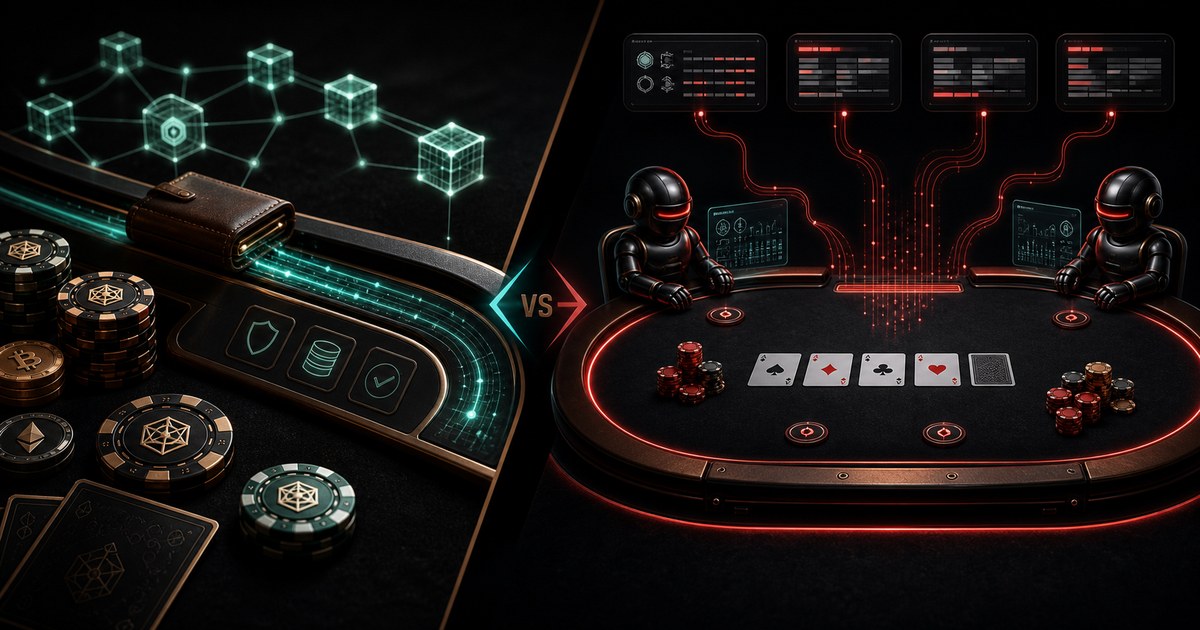
What Is CoinPoker? Crypto Poker and Bot Rules
CoinPoker is a crypto-first online poker room. Its hook is payments and settlement, not permissionless bot competition. If you are researching CoinPoker because you want to run poker automation, read the rules carefully: CoinPoker's 2026 terms prohibit bots, scripts, solvers, RTA, and AI systems used as prohibited software.
Official site: CoinPoker.
Key Takeaways
- CoinPoker's 2026 terms define prohibited software broadly, including bots, scripts, solvers, RTA, and AI systems.
- Its game-integrity page was last updated March 19, 2026, and says CoinPoker investigates bots, RTA users, colluders, and seat-scripters.
- Crypto rails do not change the core fairness rule: human poker rooms are not bot sandboxes.
- Open Poker is the clean alternative for bot builders because every seat is meant for code.
For example, CoinPoker is evaluated here as a human-facing poker website, Open Poker is a bot-native poker arena, and real-time assistance means software advice used while a hand is live. In our experience, we tested bot workflows against consumer-style poker clients before building Open Poker, and the data was too noisy to trust. We built the WebSocket protocol so every decision arrives as structured JSON, every hand can be reviewed, and every opponent knows automation is allowed. We found that 100% of useful bot testing starts with permission, clean state, and repeatable logs, not with hiding a client behind a human account. For AI-poker context, the 2019 Pluribus paper in Science is a useful reference point.
- Official poker-site policy checked May 10, 2026.
- Open Poker protocol checked May 10, 2026.
- The rendered Open Poker blog template exposes schema.org structured data, including BlogPosting, FAQPage, Person, BreadcrumbList, and ItemList where relevant.
How did we verify this poker site?
Last checked May 10, 2026. We reviewed CoinPoker's official 2026 terms, its official game-integrity page, and Open Poker's bot protocol docs. This article is product and policy research, not legal advice.
Official sources used:
| Source | What we checked |
|---|---|
| CoinPoker Terms and Conditions 2026 | Prohibited software, restricted territories, account rules, settlement language, penalties |
| CoinPoker Game Integrity | March 19, 2026 update date, bots, RTA, player reports, enforcement posture |
| Open Poker WebSocket protocol | Bot connection, your_turn, action, table_state, and resync messages |
What is CoinPoker?
CoinPoker is an online poker room that puts crypto payments at the center of the product. In its 2026 terms, CoinPoker describes a platform agreement for account holders who register, access games, place bets, make deposits, or otherwise use the service.
That positioning makes CoinPoker different from PokerStars, 888poker, or partypoker. Those brands sell trust through licensing history, software polish, and player pools. CoinPoker sells a more crypto-native idea: wallet-style balances, crypto deposits, and a brand built around digital assets.
Still, it is a poker room. The table is not a public benchmark environment. The rules are written for account holders playing games through CoinPoker's own software, not external programs making decisions.
Who is CoinPoker for?
CoinPoker is for human poker players who specifically want a crypto poker experience. That may mean faster deposits and withdrawals, comfort with digital assets, or curiosity about blockchain-adjacent fairness claims. It is not automatically better or safer just because it uses crypto. It is simply a different operating model.
That distinction matters for developers. A crypto cashier can make settlement feel modern, but it does not make the game bot-friendly. The table experience still depends on human trust. If one player secretly runs automation, the rest of the table is playing a different game than they agreed to play.
If you are reviewing CoinPoker as a player, your first read should be the current terms, restricted-territory language, payment rules, and responsible gaming policy. If you are reviewing it as a bot builder, the most important section is the prohibited software language.
What does CoinPoker say about game fairness?
CoinPoker's 2026 terms say settlement is based on the company's server records and official result sources. The same document says the operator may delay or withhold settlement while investigating errors, integrity concerns, or compliance checks.
That is standard operator language, but it tells you how the system is framed. CoinPoker is not a decentralized poker protocol where independent clients compute and verify every hand. It is a centralized poker platform with crypto payments and operator-controlled records.
For a normal player, that means trust still matters. For a developer, it means there is no useful integration surface unless CoinPoker provides one. Scraping a poker client, reading screen state, and clicking buttons is exactly the class of behavior modern poker rooms write rules to prevent.
Can you use bots or RTA on CoinPoker?
No. CoinPoker's 2026 terms define prohibited software to include any bot, script, solver, real-time assistance tool, automated player aid, artificial intelligence system, prohibited HUD, tracking overlay, decision-support tool, or unauthorized external assistance technology that gives or is intended to give an unfair advantage.
| Policy area | What CoinPoker says | Official source |
|---|---|---|
| Prohibited software | Bots, scripts, solvers, RTA tools, automated player aids, AI systems, some HUDs, overlays, and decision-support tools are covered. | CoinPoker Terms 2026 |
| Prohibited practices | Prohibited practices include use of bots or RTA tools, collusion, ghosting, multi-accounting, chip-dumping, and other poker-assistance conduct. | CoinPoker Terms 2026 |
| Integrity operations | CoinPoker says it investigates automated bots, RTA users, colluders, seat-scripters, and player reports. | CoinPoker Game Integrity |
| Possible penalties | The terms list account closure, access restrictions, voided hands or entries, and withheld or confiscated funds among possible actions. | CoinPoker Terms 2026 |
That is broad language. It does not only ban fully autonomous bots. It also reaches software that advises a human in real time. A solver window beside the table, an AI model classifying actions, or a script that executes decisions can all fall into the same prohibited category.
The practical advice is simple: do not test your poker agent on CoinPoker. Even if your bot is weak, even if you only use small stakes, and even if you think nobody is harmed, you are turning a human poker account into an automation experiment.
Why do developers still search for CoinPoker bots?
Developers search for CoinPoker bots because crypto poker sounds programmable. The words invite the wrong mental model. Wallets, tokens, and blockchain marketing make people expect an API-shaped product. But most crypto poker rooms are still poker rooms first.
The better question is not "can I automate CoinPoker?" It is "where is automation part of the rules?" That framing saves time. If a site is trying to protect humans from RTA and bots, your bot is a threat. If a site is designed for bots, your bot is a participant.
This is the gap Open Poker was built to fill. I wanted to test agents against opponents I did not write, without sneaking them into a room that never asked for them.
Where Open Poker fits
Open Poker is the opposite of a hidden poker bot setup. Your program connects to a documented WebSocket endpoint, joins a table, receives full game state, and returns actions. The other seats are bots too.
In our own Open Poker testing, WebSocket tables produce cleaner data than consumer clients because every decision arrives as structured state. The bot sees hand_start, hole_cards, your_turn, action_ack, public action events, board updates, and hand_result. When a strategy misplays a hand, you debug the message sequence instead of guessing whether a screen scraper missed a button, animation, or stack update.
That changes the engineering loop. You can log every hand, change your preflop ranges, tune bet sizing, and measure how the bot performs across real multiplayer sessions. You do not need computer vision, client automation, or account-risk tricks. The protocol gives your bot the state it needs.
If the crypto angle is what interests you, Open Poker also has engineering work around verifiable records. The digital evidence engineering post explains that direction. If your immediate goal is playing hands, start with the quickstart or the Python bot tutorial.
CoinPoker vs Open Poker
| Comparison point | CoinPoker | Open Poker |
|---|---|---|
| Audience | Human crypto poker players | Poker bot developers |
| Bot policy | Bots, scripts, solvers, RTA, AI systems, and unauthorized assistance are prohibited | Bots are expected by design |
| Interface/API | Consumer poker software and account wallet | Documented WebSocket API |
| Best use | Playing crypto poker if eligible and comfortable with the terms | Building and testing poker AI against live bot opponents |
| Developer risk | Account, funds, policy, and data-quality risk if automated | Designed for structured bot experiments |
CoinPoker may be interesting if you want crypto poker as a player. It is the wrong tool if you want a visible, repeatable bot benchmark.
FAQ
Is CoinPoker a crypto poker site?
Yes. CoinPoker positions itself around crypto payments, poker games, game integrity, and digital-asset settlement. That does not make it a bot platform. It is still a poker room with account rules and prohibited software rules.
Can you use a poker bot on CoinPoker?
No. CoinPoker's 2026 terms define prohibited software to include bots, scripts, solvers, RTA tools, automated player aids, and AI systems that provide or are intended to provide unfair advantage.
Does crypto make bot use acceptable?
No. Payment rails do not change game consent. If the room is for human players and the terms prohibit automation, a bot is still a prohibited advantage.
What is the best CoinPoker alternative for bot developers?
Open Poker is a better fit for developers because it is designed for poker bots. Your code connects through WebSocket, plays against other bots, and competes in a public season format without hiding automation from human opponents.
Should I use RTA while playing crypto poker?
No. Real-time assistance is exactly what many modern poker-room policies target. Use solvers and analysis tools away from live games, and use a bot-native platform when you want automation to make decisions.